
Spray tan extractors for UK mobiles and home booths — when you need one and what to look for
If you spray tan from a pop-up tent in a client’s spare room, a garage conversion, or a small home booth, you already know the silent extra guest at every session: overspray. Fine DHA mist settles on floors, soft furnishings and your own clothes long after the client has left. That is where a spray tan extractor earns its keep — not as marketing theatre, but as practical ventilation for real UK working spaces.
This guide is for mobile therapists and home-based studios who want a clear answer to three questions: when do you actually need an extractor, what should you check before you buy, and how does it fit alongside your machine and solution choices? For current options on the site, start with our extractors chart, then cross-check machines on the tanning machines page and solutions on spray tan solutions.
What a spray tan extractor actually does
An extractor is a compact fan unit — often with a washable or replaceable filter — designed to pull airborne overspray away from the client and the room. It will not capture every droplet; nothing does. Used well, though, it cuts the mist that hangs in still UK rooms, especially in autumn and winter when windows stay shut and central heating is on.
Think of it as risk reduction for three things: cleaner kit and interiors, a more professional finish for the client, and less residual smell or stickiness on surfaces you did not mean to tan. It sits at the back of a tent flap, beside a booth opening, or on a short duct run to outside air where the layout allows.
When you need one — and when you can wait
Strong reasons to use an extractor
- Shared or rented rooms — living rooms, hotel suites, salon corners you do not own. Landlords and venue managers notice stained skirting boards faster than you think.
- Home booths with limited airflow — conservatories, loft rooms and box bedrooms with one small window struggle to clear mist between clients.
- Back-to-back bookings — if you are spraying every 30–45 minutes, residual mist builds up before the last session is dry.
- Darker or higher-DHA solutions — richer formulas can leave more visible settling on pale carpets and PVC flooring.
- Mobile work in client homes — you are a guest; leaving less evidence of overspray protects your reputation.
Situations where ventilation alone may be enough (for now)
- Occasional home use for yourself or family in a well-ventilated utility space with easy-wipe floors.
- Outdoor summer tents with a steady breeze (rare in British weather, but it happens).
- Very low-volume practice while you are still choosing a booth layout — though planning for an extractor early is cheaper than redecorating later.
Many UK mobiles treat an extractor as essential kit once they move past “hobby sessions” into paid work. That is a commercial judgement, not a legal one — always check your own insurance wording and any landlord or salon rules rather than treating this as advice.
Mobile tent vs fixed home booth
Pop-up tents are the UK mobile default. An extractor usually sits behind the rear flap so it draws mist out of the spray zone while you work from the front. Look for a unit that is light enough to carry with your HVLP, packs flat or stays compact in the car, and has a filter you can rinse after a busy Saturday of weddings.
Fixed home booths give you more options: a dedicated extractor mounted low behind the client, optional ducting toward an exterior vent, and quieter running because the unit is not fighting a flapping tent. Noise matters if your booth shares a wall with a nursery or home office.
Either way, pair the extractor with sensible technique: correct gun distance, controlled passes, and a solution that suits the client’s skin — see the solutions chart on spray tan products if you are refreshing your bottle line-up for the season.
What to look for when you buy
- Airflow that matches your space — a tiny USB desk fan is not an extractor. You want a purpose-built spray-tan unit with enough pull for a tent or small booth, without hurricane-level noise that makes clients shout.
- Filter type — washable filters cut running costs for busy mobiles; disposable pads are convenient if you prefer a swap-and-go routine. Check how often the maker suggests cleaning; clogged filters quietly kill performance.
- Portability and power — UK mobiles need a sensible carry weight, a stable base on uneven floors, and a standard UK plug. Extension leads should be rated for continuous fan use, not a flimsy Christmas-tree cable.
- Noise in real rooms — listen in person if you can, or read recent user notes. A unit that sounds fine in a warehouse demo can feel loud in a Victorian terrace bedroom.
- Hose or flap fit — confirm how it couples to your tent or booth. Ill-fitting gaps send mist around the extractor instead of through it.
- Cleaning and parts — spare filters, easy-wipe housings, and UK stock of consumables matter more after year two than the day-one price.
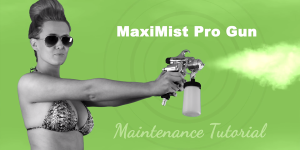
Brands that have long been popular with UK therapists for extraction and spray systems — including MaxiMist-style setups in many salons — are worth comparing on airflow, quietness and filter cost rather than logo alone. Stay independent: match the kit to your booth, not the other way round. Browse current listings on the extractors page alongside HVLP machines so the fan and gun work as a pair.
UK practicalities: homes, rentals and insurance (high level)
Spray tan overspray is messy, not mysterious. In rented flats and shared buildings, protection often comes down to wipeable flooring, covering nearby soft furnishings, and extracting mist so it does not travel under doors. If you work mobile, ask venues in advance whether extractors or windows-open policies are preferred.
Public liability and treatment risk insurance policies sometimes mention ventilation, equipment maintenance or working-from-home conditions. Read your schedule; this post is not legal or insurance advice. If in doubt, ask your broker whether your booth or tent setup — including extractor use — sits comfortably within cover.
For autumn and winter bookings, remember that clients arrive in jackets and leave into heated cars. Good extraction plus sensible rinse timing and aftercare keeps the tan looking even when the weather does not cooperate.
How to use an extractor well (simple routine)
- Position the unit so it pulls from behind or beside the client, not into your face as you spray.
- Switch on before the first pass; give it a few seconds to establish airflow.
- Keep tent flaps and booth doors managed so you do not create a short-circuit of air that bypasses the filter.
- After the session, run the extractor another minute while you tidy — leftover mist is what stains the room later.
- Rinse or replace filters on a schedule tied to how many full tans you do each week, not “when it looks bad”.
Extractor vs open window vs air purifier
An open window helps on mild days but is unreliable in rain, pollution-heavy roadsides, or cold evenings when clients will not thank you for a draught. Domestic HEPA air purifiers are built for dust and pollen, not wet DHA aerosol at spray distance — they may help the wider room slightly, yet they are not a substitute for a spray-tan extractor aimed at the mist source.
The extractor’s job is local capture at the booth. Everything else is a bonus.
Quick buyer checklist
- Is my main workspace a mobile tent, a fixed booth, or both?
- Do I spray in client homes or shared buildings where tidy exit matters?
- Can I carry the unit plus my HVLP in one trip from the car?
- Are washable filters available in the UK without long waits?
- Have I compared noise and airflow, not just price?
- Does my insurance or landlord agreement say anything useful about ventilation?
If most answers point to “yes, I need proper extraction,” put the extractor on the same priority list as a reliable gun — then fine-tune solutions and technique. Machine choice still matters for atomisation and comfort; recent HVLP write-ups on SprayTan.net are useful companion reading when you are upgrading the whole kit bag.
Bottom line
You do not need an extractor for every single practice spray in a wipe-clean utility room. You do need a serious look at extraction once you are taking money in tents, home booths, or other people’s houses — especially through the British seasons when rooms stay closed and bookings stack up. Choose for airflow, filters, portability and noise; maintain it like the working tool it is; and keep your extractor, machine and solution choices aligned so the client leaves with a tan — and the room looks like you were never there.







Leave a Reply